Ugly Charts of US Auto Sales, 2025: Stellantis, Nissan Flirt with Catastrophe. GM, Ford, Honda Sales Rise but far below Peaks. Toyota & Hyundai-Kia Set Records
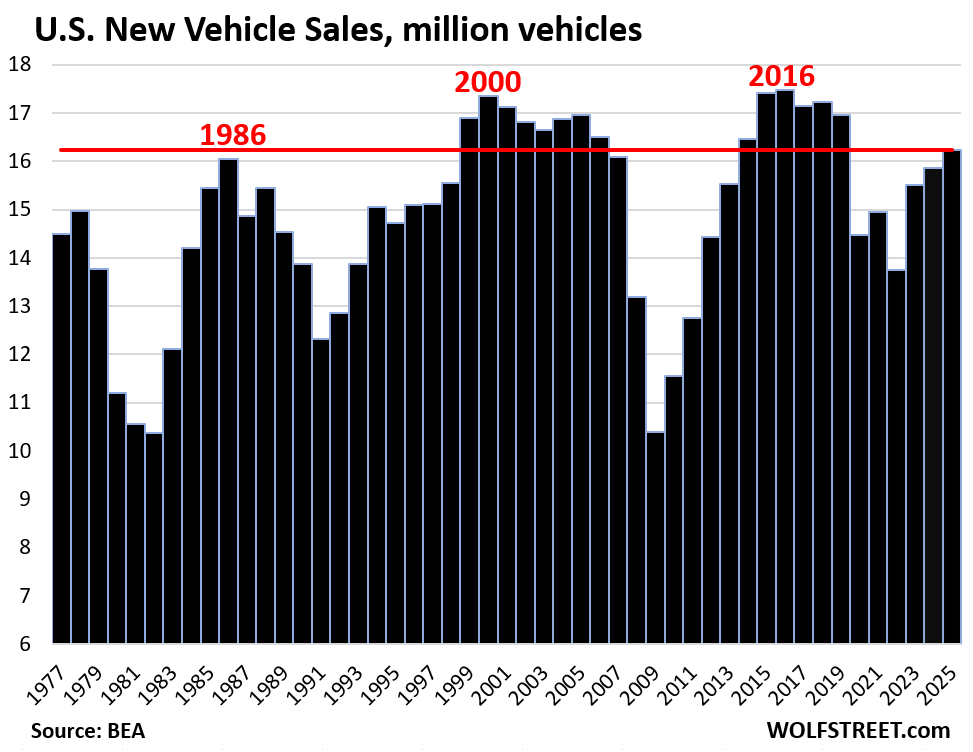
New-vehicle sales in 2025 rise barely above 1986: Four decades of structural stagnation, plunges, and partial recoveries.
By Wolf Richter for WOLF STREET.
Total new-vehicle sales, as measured by deliveries to end users, rose by 2.4% in 2025 to 16.2 million vehicles, the highest since 2019, and just a hair above where sales had been in 1986 – four decades of structural stagnation, plunges, and partial recoveries. The two best years were 2000 and 2016, with 17.4 million and 17.5 million vehicles sold. In 2025, sales were 6.4% below the year 2000. Over those 25 years, the US population has increased by 21%!
Stellantis continued its death spiral, with sales dropping further in 2025, down by 44% from the high in 2015; Nissan may have paused its death spiral, with sales roughly flat year-over-year, and down 42% from the 2017 high. GM’s and Ford’s sales have come up, but are still well below their 2015 levels. Honda also eked out a gain for the year, but sales were still down 13% from the peak in 2017. Toyota’s sales jumped and surpassed its 2015 record by a hair. Hyundai-Kia sales continued to surge from record to record. And Tesla doesn’t report US sales publicly – it only reports global sales publicly, which dropped for the second year in a row (overall new-vehicle sales data via Bureau of Economic Analysis):
Full-year sales by all automakers combined rose on the strength of Q3 when EV sales surged due to frontrunning the end of the federal incentives; and on the strength of March and April due to frontrunning the tariffs.
Each frontrunning stampede was followed by a hangover. In Q4, sales dropped by 4.2% year-over-year, as some of the big automakers reported substantial drops.
The top foreign automakers assemble a big portion of their US-sold vehicles in the US, and many of their vehicles have more US content than those of GM, Ford, and Stellantis. Most US-sold Tesla models are at the top or near the top with their percentage of US content.
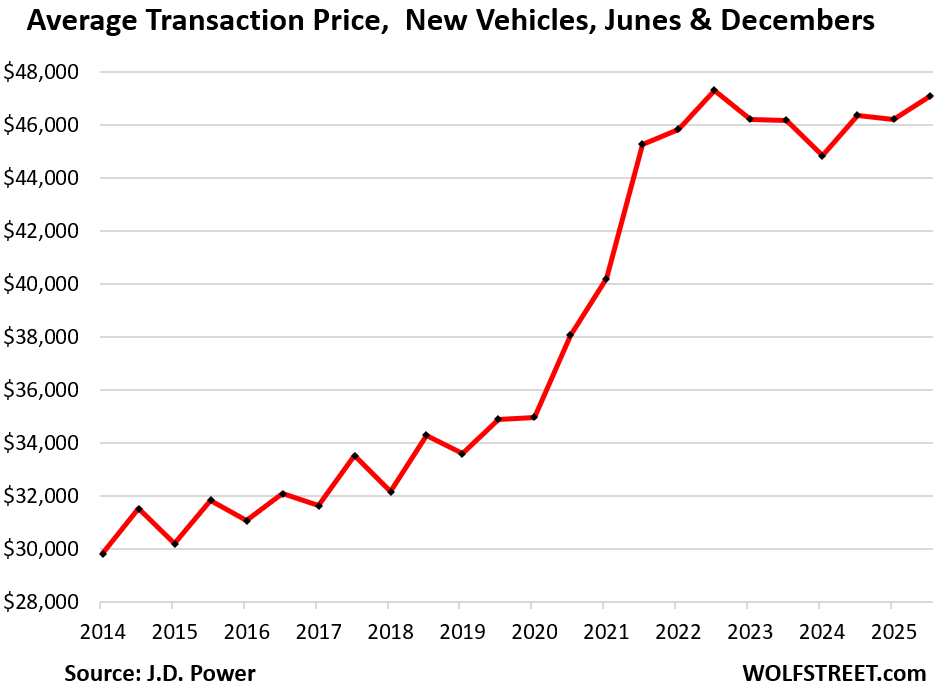
Prices exploded in 2020-2022 and hit a ceiling.
In 2020-2022, automakers and dealers went crazy with their price spikes. Over the three years from the beginning of 2020 through the end of 2022, the average retail transaction price had exploded by 36%. After the price explosion that led to obscene profit margins at automakers and dealers, price increases ran into a consumer revolt, which is why the tariffs couldn’t be passed on without losing sales.
Automakers have always tried to go upscale, coming out with fancier, bigger, and more expensive models, which is how they boosted their revenues in a market that has been structurally stagnating in terms of unit sales for four decades.
In addition, they raised prices across the board with annual increases in the MSRPs, and adjusting actual prices throughout the year with various incentives and discounts.
The result is that new vehicles are now too expensive. The average retail transaction price peaked at the end of 2022 at $47,329 and has remained roughly at that level since then. At the end of 2025, the average transaction price was $47,104, up by 1.5% from a year ago, and down by 0.5% from three years ago, according to JD Power estimates. The average retail transaction price includes all incentives and discounts.
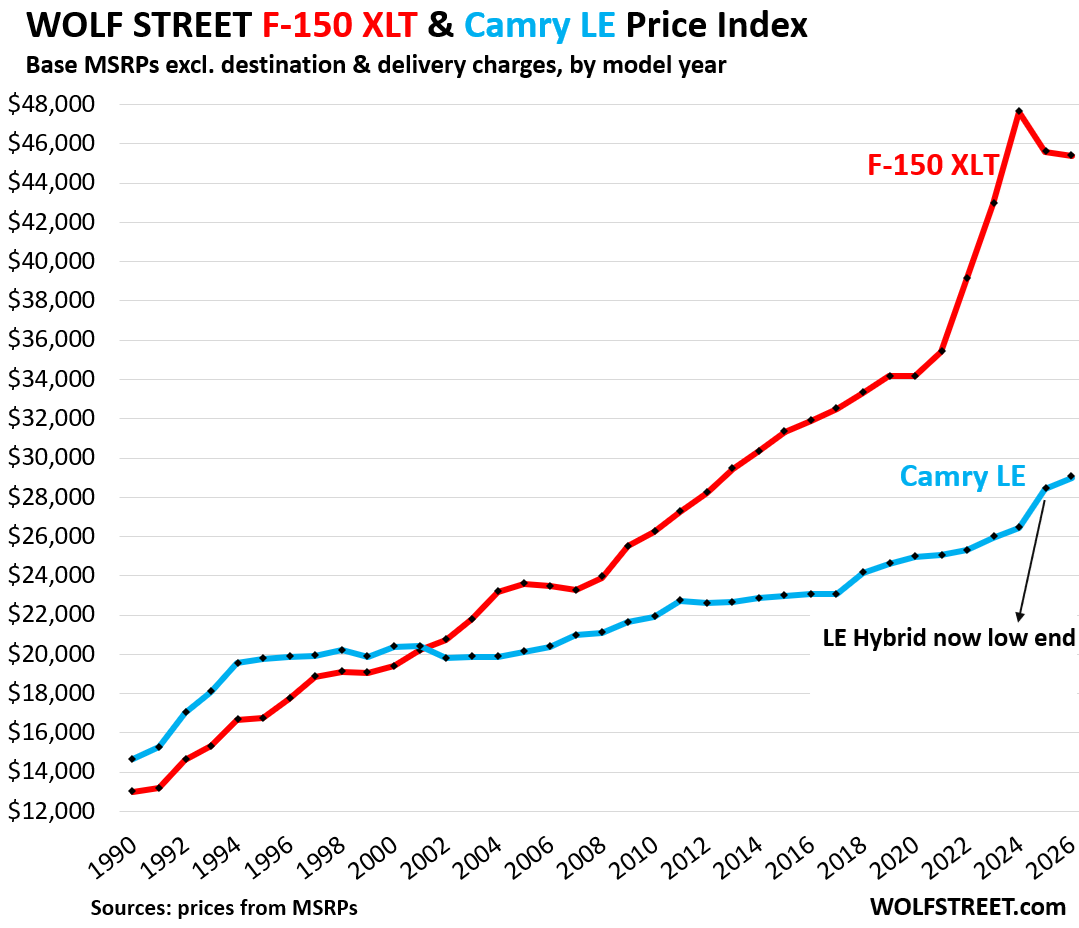
The WOLF STREET F-150 XLT & Camry Price Index tracks the MSRPs of the base versions of the Ford F-150 pickup truck and the Toyota Camry LE going back to 1989. Over the three model years 2022, 2023, and 2024, the MSRP of the F-150 spiked by 34.5%, but then hit that ceiling.
Toyota did the classic trick of upscaling the base Camry LE by making the hybrid drive standard in the 2025 model year, which had been a $2,400 option in the 2024 model year, and then raising the MSRP by about $2,000 to reflect that (details in my discussion here):
Sales of the biggest automakers in the US.
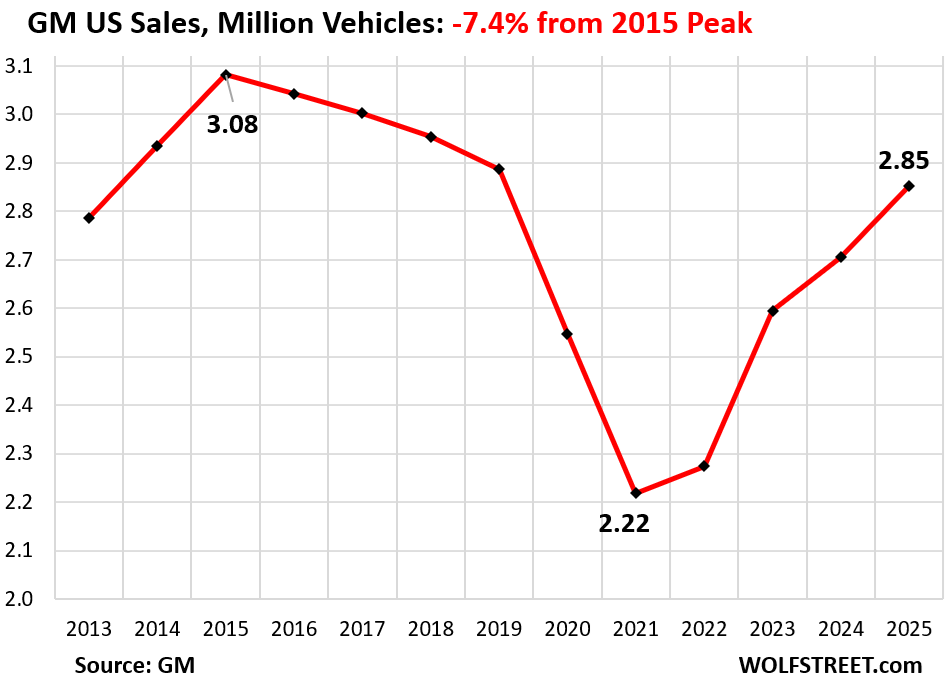
#1, General Motors: In Q4 sales fell by 6.9% year-over-year to 703,001 units. For the whole year 2025, sales rose by 5.5%, to 2.85 million vehicles, on the strength of frontrunning in Q1 and Q3.
It sold 940,000 full-size pickup trucks across all its truck brands combined, more than any other automaker, including Ford, which sold 829,000 full-size pickup trucks.
But the year total was still down by 7.5% from the 2015 peak.
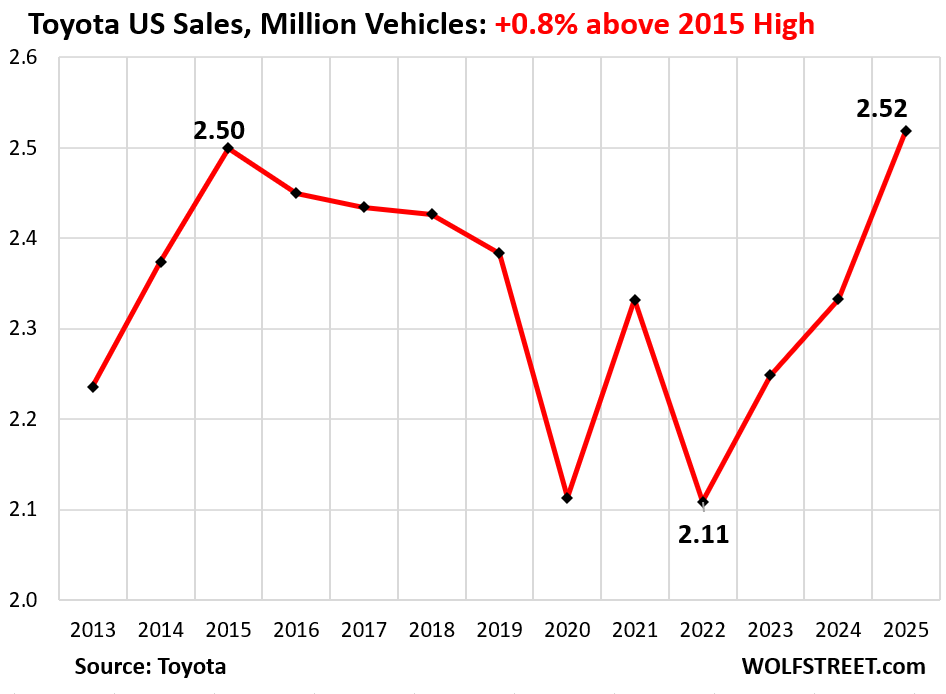
#2, Toyota: Sales of Toyota and Lexus brands combined jumped in Q4 by 8.1% year-over-year, to 652,195 vehicles.
Sales for the whole year jumped by 8.0%, to 2.52 million vehicles, squeaking by the peak in 2015 by 0.8%.
It sold 248,088 Corollas (+6.5% YoY), 316,185 Camrys (+2.0% YoY), and 56,488 Priuses, the subcompact liftback sedan (+26% YoY). That’s 620,000 sedans, about a quarter of Toyota’s total sales, not including the niche cars that Toyota also sells.
This is the kind of market that Ford, GM, and Stellantis, in their infinite wisdom of always kowtowing to Wall Street, abandoned years ago. Sedans have tighter profit margins than the big iron, and Wall Street hated that. So, under pressure to show higher profit margins, the automakers just handed most of the sedan business to foreign brands and Tesla.
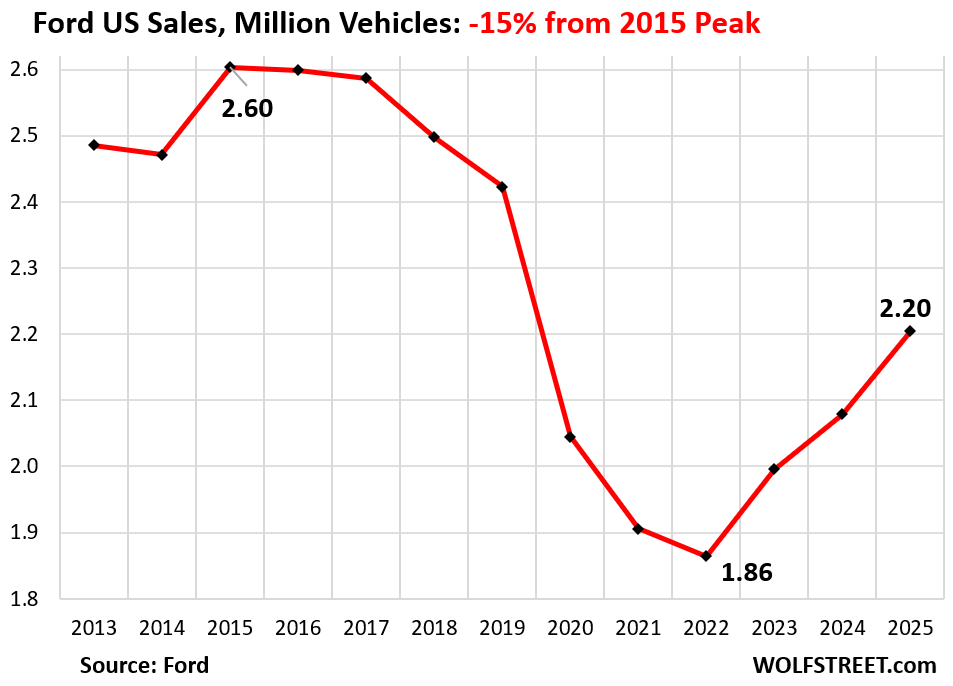
#3, Ford: Sales by Ford and Lincoln brands combined in Q4 rose by 2.7% year-over-year.
For the whole year, sales rose by 6.0% to 2.20 million vehicles, but that was still down by 15% from the recent peak in 2015!
The only car that Ford still sells in the US is the Mustang. That sedan business that Ford sacrificed on the altar of Wall Street sure is missing now.
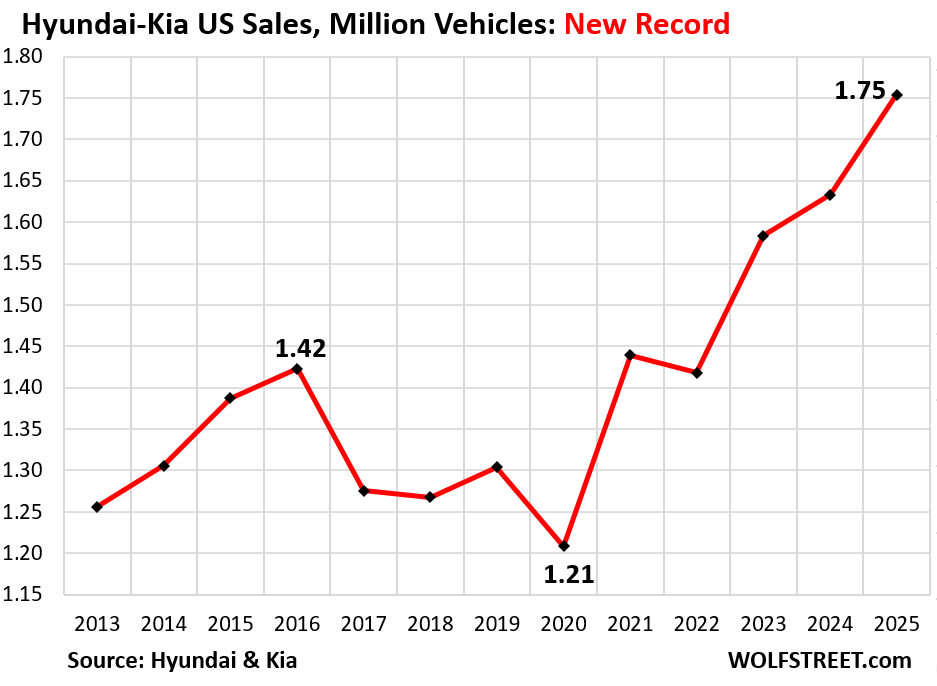
#4, Hyundai-Kia: Combined sales jumped by 7.4% in 2025, to a record 1.63 million vehicles, up by 26% from the 2015 high. Hyundai sales were up 7.8%, Kia sales 7.0%. But Q4 sales were barely up from a year ago.
Hyundai is the parent company of Kia, with Hyundai holding a 33.9% stake in Kia, and Kia holding stakes in Hyundai subsidiaries, and they share vehicle platforms. For our purposes here, the duo counts as one automaker with different brands.
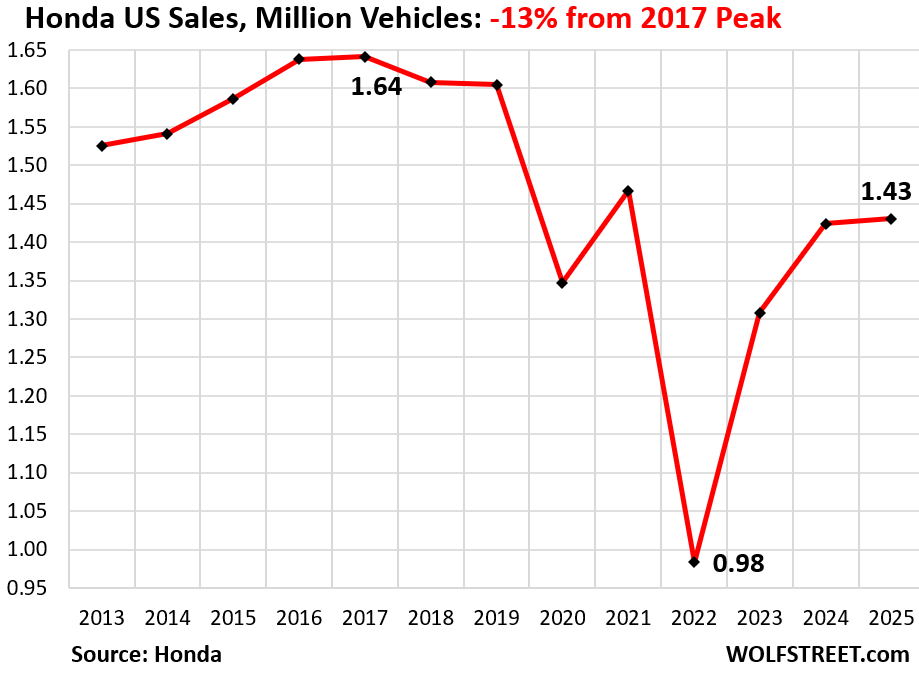
#5, Honda: Quarterly sales plunged by 9.5% year-over-year to 332,578 vehicles, with December down 12.5% year-over-year, but…
Thanks to Q1 and Q3, full-year sales inched up by 0.5% to 1.43 million vehicles. Honda sold 417,269 sedans, about 41% of its total sales.
2025 was the second year that Honda was the #5 automaker in the US. In 2024, it had moved past Stellantis, whose sales had collapsed.
But sales in 2025 were still down by 13% from the 2017 peak.
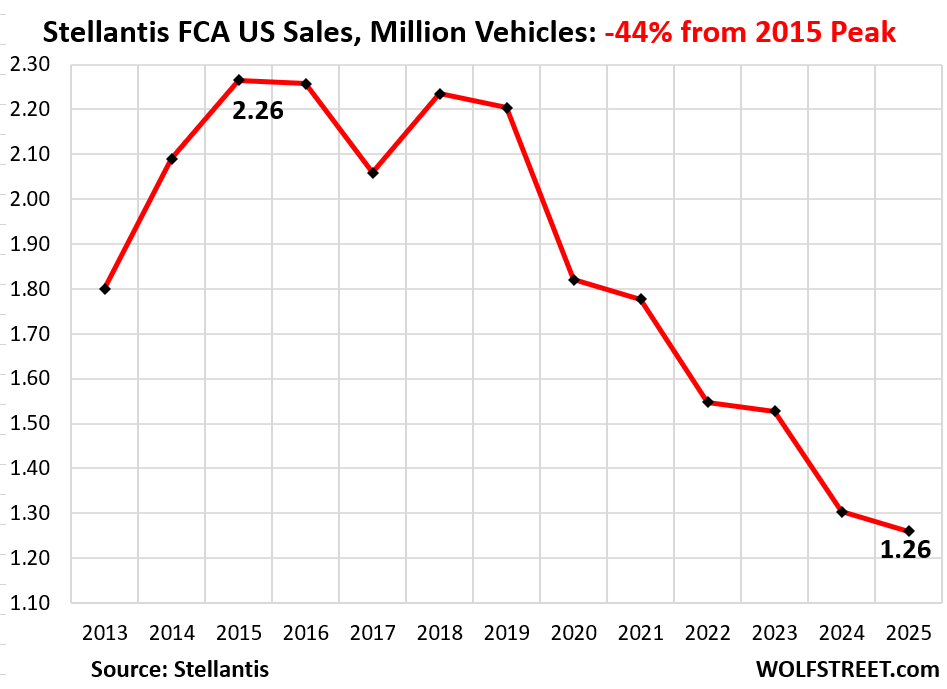
#6, FCA US (Stellantis): The death spiral continued in 2025. FCA US sales all brands combined – Jeep, Ram, Chrysler, Dodge, Fiat, and Alfa Romeo – dropped another 3% in 2025, to 1.26 million vehicles. From the recent peak in 2015, sales have collapsed by 44%.
- Jeep: 593,401 (+1%)
- Ram: 431,670 (-2%)
- Chrysler: 126,373 (+1%)
- Dodge: 101,927 (-27%)
It sold only minuscule numbers of Fiats (-14%) and Alfa Romeos (-36%) in 2025.
The shares of Stellantis [STLA], which are traded on the NYSE, have collapsed by 62% from their high in March 2024.
This is an ultra-ugly chart of an existential crisis. But there’s always hope: Q4 sales were up 4% year-over-year:
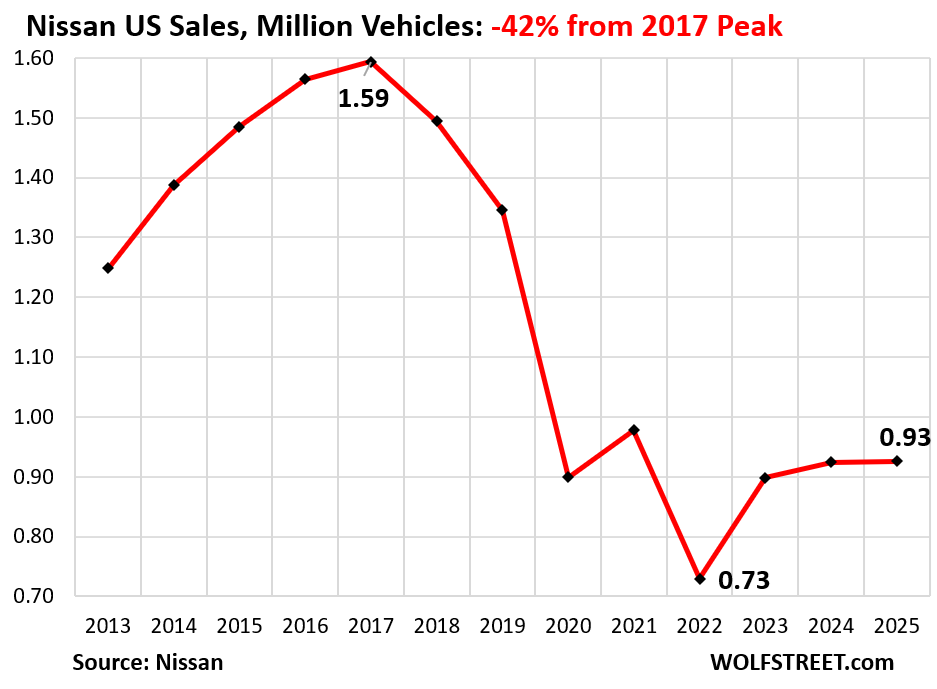
#7, Nissan: Sales of Nissan and Infiniti combined were roughly flat year-over-year in 2025 at 926,153 vehicles, with Nissan Division sales edging up 0.9% and Infiniti sales plunging 9.0%.
Q4 sales dropped by 3.7% year-over-year to 214,250 vehicles.
From the recent peak in 2017, sales have plunged by 42%. Another ultra-ugly chart of an existential crisis, not far behind Stellantis.
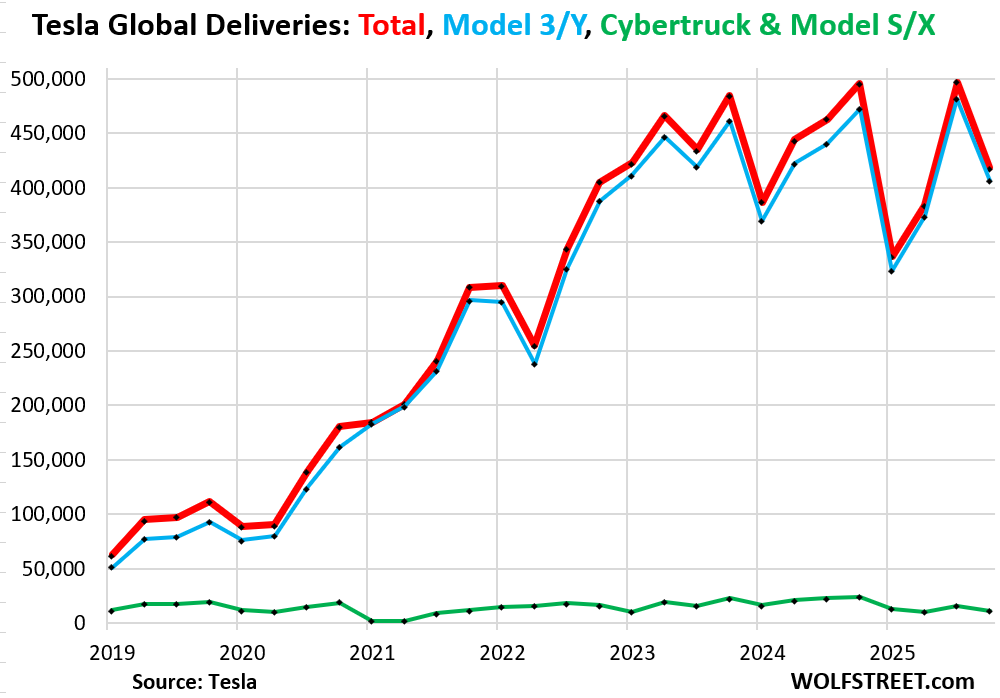
Tesla doesn’t publicly disclose US sales. It only publicly discloses global sales. Tesla’s global sales in Q4 plunged by 15.6% from a year ago. For the whole year, global sales dropped by 8.6%, the second year in a row of declines (full discussion here). Preliminary estimates indicate that the drop in the US was steeper still.
Enjoy reading WOLF STREET and want to support it? You can donate. I appreciate it immensely. Click on the mug to find out how:


WOLF STREET FEATURE: Daily Market Insights by Chris Vermeulen, Chief Investment Officer, TheTechnicalTraders.com.
link